Lighting basics
How to choose a luminaire by its light rather than its wattage: brightness, colour of light, protection from dust and water.
Lumens, watts and brightness
A luminaire's brightness is measured in lumens (lm), not watts. Watts are the power draw — how much electricity the fixture uses, not how much light it makes. LEDs give roughly 80–120 lumens per watt, so a 15 W LED fixture is as bright as an old 100 W incandescent bulb.
The rule is simple: more lumens, more light. A task lamp needs 400–600 lm, a room several thousand, a warehouse or workshop tens of thousands split across several fixtures.
The efficiency figure is lumens per watt (lm/W). The higher it is, the less you pay for the same light. Compare fixtures by lumens and lm/W, never by watts.
Colour temperature and CRI
The colour of light is set by colour temperature in kelvins (K). Warm 2700–3000K is yellow and cosy, for bedrooms and living rooms. Neutral 4000K is like daylight, for kitchens, offices and shops. Cool 5000–6500K is a bluish white, for warehouses, car parks and production.
Keep one temperature within a room: mixing 3000K and 4000K in the same space is visible and reads as a defect.
The second key figure is the CRI (Ra) colour-rendering index — how truthfully the light shows the colours of objects. CRI below 80 distorts colours, 80–90 is fine for home and office, above 90 is for shops where the true colour of goods, displays and fitting areas matters.
The IP rating — which fixture goes where
The protection rating is written as IP and two digits. The first is protection from dust and touch, the second from water. Higher numbers mean stronger protection.
IP20 — dry rooms: living spaces, office, hallway. IP44 — splashes: bathroom (outside the direct-water zone), kitchen by the sink, covered porch. IP54–IP65 — outdoors, damp and dusty workshops, wash bays, pools. IP66–IP68 — direct jets and immersion: façades, waterfronts, industrial yards.
Rule: for outdoors and wet zones take at least IP65. An IP20 fixture outside will fail after the first rain, and the warranty will not cover it.
Other courses
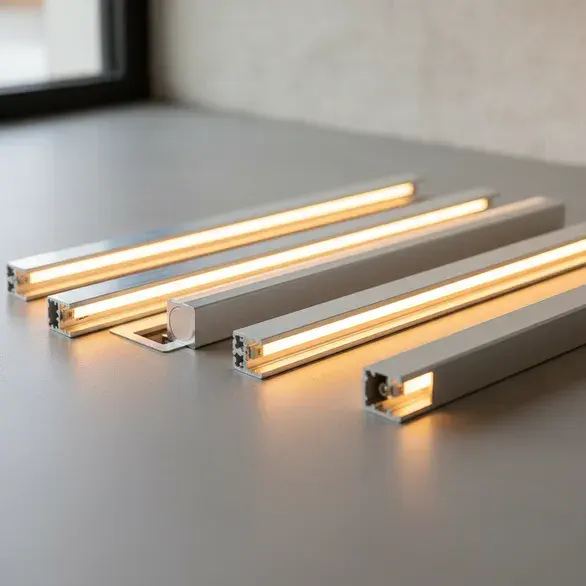
Types of LED luminaires
Recessed, surface, pendant, track, strips and outdoor floodlights — what goes where.
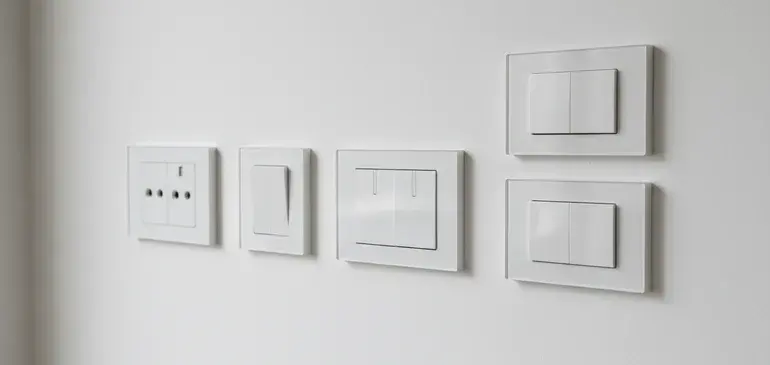
Sockets and switches
Ratings, earthing, two-way switches and dimmers, protection in wet zones.
Planning light and sockets by room
How much light and how many points a kitchen, living room or bedroom needs — and how to work it out with the Electrica calculator.