
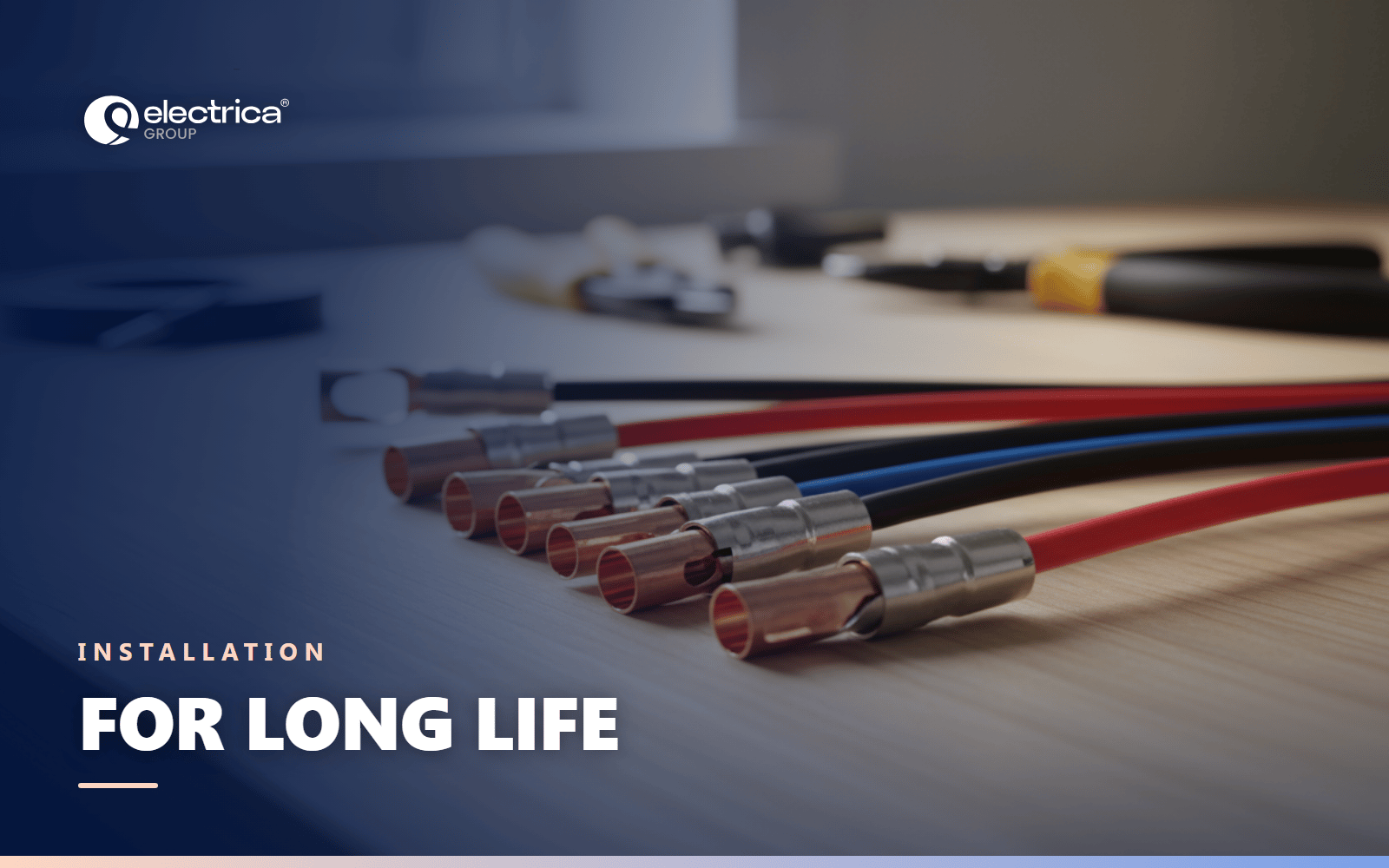
Terminals and connections
Screw, spring, WAGO, ferrule, distribution block: what to join conductors with so the joint never heats.
Screw, spring, and what lies between
A joint lasts exactly as long as its clamping force. A screw terminal applies plenty of it, but metal creeps: after a year or two the screw wants re-tightening, or the contact loosens, its resistance rises and the spot starts to warm. That is why a screw is a poor choice deep in a board nobody will open again.
A spring terminal (WAGO and its like) holds the conductor with a spring's constant force. It needs no re-tightening, tolerates vibration and assembles far faster. The price is a fixed range of cross-sections: a 2.5 mm² terminal will not take 6 mm², and there is nothing to over-tighten.
A junction box is its own case. A twist with no sleeve and no terminal is held by friction and good intentions alone: it oxidises, heats, and sooner or later becomes the point of failure. A terminal or a crimped sleeve costs pennies and settles the matter for good.
Ferrules, sleeves and dissimilar metals
A stranded flexible conductor has no business under a screw: the screw cuts some strands, the rest splay out, and what was 2.5 mm² becomes about 1.5 at the contact. A ferrule gathers every strand into one stiff pin — the screw has something to hold and the full cross-section works.
Crimp it with the right tool, not with pliers: an under-crimped ferrule heats just like a bad twist. The check is simple — you should be able to pull on the ferrule and have it stay.
Copper and aluminium must never meet directly: together they form a galvanic couple that oxidises and grows in resistance, and heat speeds the process up. The fix is a terminal with separated barrels, a bimetallic lug, or a paste that stops the oxide film forming. This is not over-caution: burnt aluminium tails in old boards are the single most common find on a rewire.
Terminal rows, bars and distribution blocks
In a board, joints are not scattered through boxes — they are gathered on a DIN rail. Feed-through terminals give one place where a circuit fans out: you can see what goes where, and any conductor lifts out without disturbing the others. Label the row; it saves hours later.
Neutral and earth get bars of their own. The PE bar must be separate and unbroken: an RCD may open the neutral, the protective conductor never opens, under any circumstances. If the board has RCDs on groups, each group needs its own neutral terminal — otherwise leakage finds its way through a neighbour's neutral and the RCD trips for no reason.
When the incoming current is large, a distribution block replaces the row of terminals: four ready poles in one housing, rated for 100–250 A. It is both tidier and more reliable than ten terminals bridged together.
Other courses

Lighting basics
How to choose a luminaire by its light rather than its wattage: brightness, colour of light, protection from dust and water.
Types of LED luminaires
Recessed, surface, pendant, track, strips and outdoor floodlights — what goes where.
Sockets and switches
Ratings, earthing, two-way switches and dimmers, protection in wet zones.